Quiz: My Room (있다/없다)
Test your understanding of the key Korean words and grammar from the story 'My Room'.
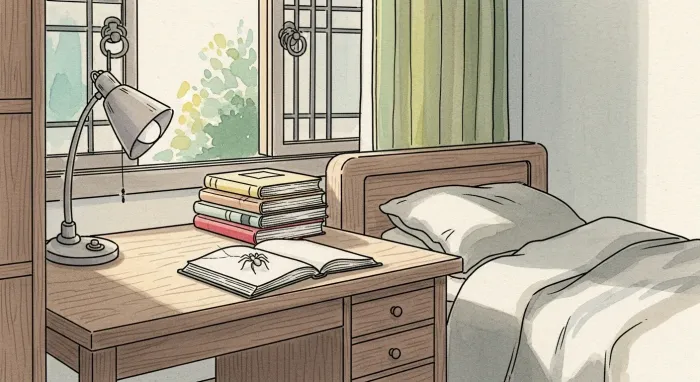
na-ui bang
나의 방
My Room
na-neun nae bang-eul bon-da.
나는 내 방을 본다.
I look at my room.
bang-e chaek-sang-i it-da.
방에 책상이 있다.
In the room, there is a desk.
chim-dae-do it-da.
침대도 있다.
There is also a bed.
geu-ri-go chang-mun-i it-da.
그리고 창문이 있다.
And there is a window.
na-neun chaek-sang-eul bon-da.
나는 책상을 본다.
I look at the desk.
chaek-sang wi-e-neun chaek-i it-da.
책상 위에는 책이 있다.
On the desk, there is a book.
seu-taen-deu-do it-da.
스탠드도 있다.
There is also a lamp.
keom-pyu-teo-neun eop-da.
컴퓨터는 없다.
There is no computer.
i-je na-neun chaek-eul bon-da.
이제 나는 책을 본다.
Now I look at the book.
chaek wi-e mu-eot-i it-da.
책 위에 무엇이 있다.
There is something on the book.
jak-eun geo-mi-ga it-da.
작은 거미가 있다.
There is a small spider.
geo-mi-neun ga-man-hi it-da.
거미는 가만히 있다.
The spider is still.
na-neun chang-mun-eul yeon-da.
나는 창문을 연다.
I open the window.
i-je chaek wi-e-neun geo-mi-ga eop-da.
이제 책 위에는 거미가 없다.
Now, on the book, there is no spider.
Practice writing Hangul and review words in example sentences so they stick.
Test your understanding of the key Korean words and grammar from the story 'My Room'.
To express that something exists or is present in a location (“there is…”), you use the verb 있다 (itta). To express that something does not exist or is absent (“there is not…”), you use the verb 없다 (eopda).
This is also used to express possession (e.g. “I have a book”).
The noun that exists or doesn’t exist is marked with the subject particle 이/가.
The choice depends on whether the noun ends in a consonant or a vowel:
If the noun ends in a consonant, use 이 (i).
If the noun ends in a vowel, use 가 (ga).
| English | Korean Sentence | Romanized |
|---|---|---|
| There is a book. | 책이 있다. | Chaeg-i itda. |
| There is a chair. | 의자가 있다. | Uija-ga itda. |
| There is no time. | 시간이 없다. | Sigan-i eopda. |
To specify where something exists, you can add a location noun followed by the location particle 에 (e).
The same form is used to express possession of an object.
| English | Korean Sentence | Romanized |
|---|---|---|
| I have a book | 나는 책이 있다. | na-neun chaek-i itda. |
| I have a chair. | 나는 의자가 있다. | na-neun uija-ga itda. |
| I don’t have time. | 나는 시간이 없다. | na-neun sigan-i eopda. |
In this case, you usually use the topic particle 은/는. Recall that the topic particle can be though of as saying as for… So you can imagine that:
The Korean particle 도 (do) is a simple but powerful particle that means “also” or “too”.
The only tricky part about 도 is that it replaces other common particles like the subject particle (이/가) and object particle (을/를).
Notice how 도 takes the place of the original particle.
| Original Sentence | Meaning | With 도 | Meaning |
|---|---|---|---|
| 사과가 맛있어요. | Apples are delicious. | 사과도 맛있어요. | Apples also are delicious. |
| 물을 마셔요. | I drink water. | 물도 마셔요. | I drink water too. |
You need to use the context of the sentence to determine if the word with 도 is the subject or object.