Quiz: I Look Out the Window (Vocabulary & Grammar)
Test your understanding of the key Korean words and grammar from the story 'I Look Out the Window'.
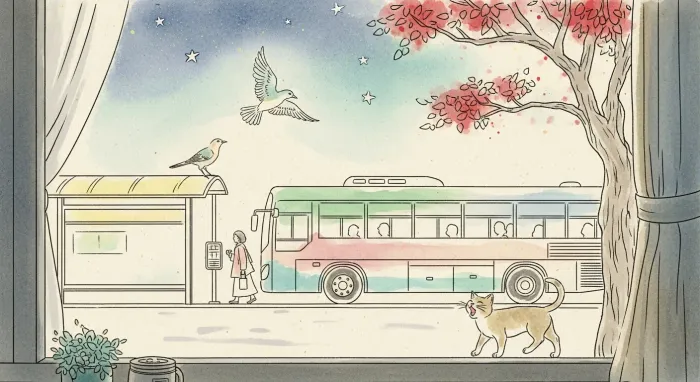
na-neun chang-bak-eul bon-da.
나는 창밖을 본다.
I look out the window.
beo-seu-ga on-da.
버스가 온다.
A bus comes.
jeong-ryu-jang-e seon-da.
정류장에 선다.
It stops at the bus stop.
sa-ram-i tan-da.
사람이 탄다.
A person gets on.
beo-seu-ga da-si gan-da.
버스가 다시 간다.
The bus goes again.
sae-ga on-da.
새가 온다.
A bird comes.
na-mu-e an-neun-da.
나무에 앉는다.
It sits on the tree.
geu-ri-go nal-a-gan-da.
그리고 날아간다.
And it flies away.
go-yang-i-ga on-da.
고양이가 온다.
A cat comes.
na-reul bon-da.
나를 본다.
It looks at me.
go-yang-i-ga un-da.
고양이가 운다.
The cat cries.
geu-ri-go go-yang-i-do gan-da.
그리고 고양이도 간다.
And the cat goes too.
i-je bam-i on-da.
이제 밤이 온다.
Now, night comes.
ha-neul-e byeol-i na-on-da.
하늘에 별이 나온다.
A star comes out in the sky.
Practice writing Hangul and review words in example sentences so they stick.
Test your understanding of the key Korean words and grammar from the story 'I Look Out the Window'.
In Korean, verbs end in 다. The most basic way to use verbs like 보다 - to look/see, 가다 - to go, or 앉다 - to sit is with the plain declarative form.
This form is often found in diaries, books, news articles, and academic papers. It carries a neutral, factual, and sometimes observational tone. It is the action verb equivalent of using 이다 - to be for nouns.
The conjugation rule depends on the last letter of the verb :
| English | Dictionary Form | Verb Stem | Rule | Plain Form |
|---|---|---|---|---|
| to see/look | 보다 (boda) | 보 (bo) | Ends in vowel | 본다 |
| to come | 오다 (oda) | 오 (o) | Ends in vowel | 온다 |
| to sit | 앉다 (anta) | 앉 (an) | Ends in consonant | 앉는다 |
This form is used to state actions as they happen, without addressing a specific person.
In Korean, to show what the object of a verb is (the thing that is receiving the action), you attach the object particle to the noun. The particle used is either 을 (eul) or 를 (reul).
This particle answers the question “what?” or “whom?” in relation to the verb. For example, in the sentence “I read a book,” “book” is the object, so it gets the particle.
The rule for choosing which particle to use is based on the last letter of the noun:
| English | Korean Noun | Rule | With Particle |
|---|---|---|---|
| meal/rice | 밥 (bap) | Ends in consonant | 밥을 (babeul) |
| bus | 버스 (beoseu) | Ends in vowel | 버스를 (beoseureul) |
Here’s how the particle works in full sentences.
It’s important not to confuse the object particle (을/를) with the subject
particle (이/가).