Quiz: Meet My Friends
Test your understanding of Korean vocabulary and grammar ('이다', '는') from the story 'Meet My Friends'.
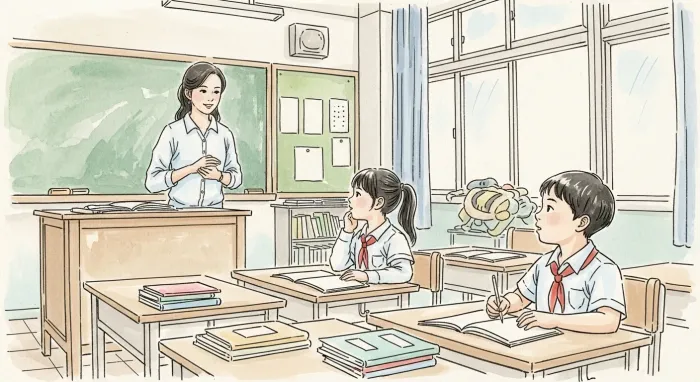
na-wa nae chin-gu-deul
나와 내 친구들
Me and my friends
an-nyeong!
안녕!
Hello!
na-neun mi-ju-ya.
나는 미주야.
I am Miju.
i-geon nae chin-gu-ya.
이건 내 친구야.
This is my friend.
nae chin-gu i-reum-eun hyeon-u-ya.
내 친구 이름은 현우야.
My friend's name is Hyunwoo.
na-neun yeo-ja-ya.
나는 여자야.
I am a girl
hyeon-u-neun nam-ja-ya.
현우는 남자야.
Hyunwoo is a boy.
u-ri-neun hak-saeng-i-ya.
우리는 학생이야.
We are students.
u-ri-neun 2-hak-nyeon-i-ya.
우리는 2학년이야.
We are second graders.
jeo sa-ram-eun u-ri seon-saeng-nim-i-ya.
저 사람은 우리 선생님이야.
That person is our teacher.
seon-saeng-nim-eun eo-reun-i-ya.
선생님은 어른이야.
Our teacher is an adult.
u-ri-neun a-jik hak-saeng-i-ya.
우리는 아직 학생이야.
We are still students.
Practice writing Hangul and review words in example sentences so they stick.
Test your understanding of Korean vocabulary and grammar ('이다', '는') from the story 'Meet My Friends'.
The Korean verb for “to be” is 이다 (ida). When speaking informally, this verb conjugates into 이야 (iya) or 야 (ya). This form is typically used when speaking with people younger than or the same age as you, but can also be used with close friends or family members.
The choice between 이야 (iya) and 야 (ya) depends on whether the preceding noun ends in a consonant or a vowel:
If the noun ends in a consonant, use 이야 (iya).
If the noun ends in a vowel, use 야 (ya).
| English | Korean Sentence | Romanized |
|---|---|---|
| I am a student. | 나는 학생이야. | Na-neun haksaeng-iya. |
| You are a doctor. | 너는 의사야. | Neo-neun uisa-ya. |
In Korean, 은 (eun) and 는 (neun) are topic particles. They attach to the end of a noun to mark it as the topic of the sentence. The topic is what the sentence is about.
It can be useful to think of it as translating to “as for…”, although in reality it simply indicates the topic, a concept which doesn’t exist in English.
| English | Korean | Romanized |
|---|---|---|
| I (as for me) am a student. | 나는 학생이야. | na-neun hak-saeng-iya |
| The teacher (as for the teacher) is an adult. | 선생님은 어른이야. | seon-saeng-nim-eun eo-reun-iya |
은/는 helps set the context for the listener, letting them know what you are going to talk about. It can sometimes imply a contrast with something else, but its primary role is to introduce or highlight the topic.