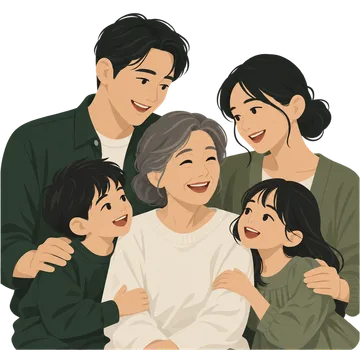
- 네neyesInterjection
An exclamation uttered when the speaker answers the call of his/her elder.
More definitions
- An exclamation uttered when the speaker affirmatively answers the call or order of his/her superior.
- An exclamation uttered when the speaker asks again what his/her superior said.
- An exclamation uttered when the speaker pesters his/her elder for something.
- 아니요aniyonoInterjection
An exclamation uttered when the speaker gives a negative answer to the question of his/her elder or superior.
- 저jeoI (humble); me (humble)Pronoun
The humble form used by the speaker to refer to himself/herself for the purpose of showing humility to the listener.
- 학생haksaengstudentNoun
A person who studies in a school.
- 선생님seonsaengnimteacher (respectful)Noun
(polite form) A person who teaches students.
More definitions
- A title placed after a person’s name, family name, or occupation to address them politely.
- (polite form) A word used to refer to an aged person respectfully.
- 제jemy (humble)No Part of Speech
An abbreviated word for '저의', a combination of '저', the self-lowering form of '나', and '의.'
More definitions
- An abbreviated word for '저의', a combination of '저', the word used to describe a third person, and '의.'
- 이름ireumnameNoun
A word used to refer to or address an animal, object, phenomenon, etc., to distinguish it from others.
More definitions
- A word used with the family name to refer to or address a specific person.
- The combination of the family and given names that is used to refer to or address a specific person.
- A word that is used to refer to or address a person, organization, etc., for the purpose of officially announcing an action they took.
- The reputation that is known to the world.
- A word that encapsulates someone's appearance, personality, behavior, etc., used to refer to or address him/her.
- The recognition of one's excellence by others and resulting honor.
- Something that one presents as an excuse or cause when he/she wants to engage in an undertaking.
- Authority or power that one depends on for support.
- 누구nuguwho; someonePronoun
A pronoun used to indicate a person that one does not know.
More definitions
- A pronoun used to indicate a random person.
- A pronoun used to indicate a person whose name does not have to be necessarily disclosed.
- 사람sarampersonNoun
A being that is capable of thinking, makes and uses languages and tools and lives by forming a society with others.
More definitions
- A person who belongs to a region, family, organization, etc.
- A being that has certain qualifications or character.
- The personality or character of a person.
- The word that is used to refer to or call a person that one feels close to.
- The word that refers to an unspecified person other than oneself.
- An extraordinary person.
- A worker or a person hired to work on a project or assignment.
- The unit of counting the number of people.
- 우리uriwe; ourPronoun
A pronoun used when the speaker refers to himself/herself and the listener or listeners, or a group of people including the speaker and listener or listeners.
More definitions
- A pronoun used when the speaker refers to several people including himself/herself while speaking to a person senior to himself/herself.
- we: A pronoun used when the speaker intimately refers to something related to him/her while speaking to the person junior to himself/herself.
- 엄마eommamomNoun
A word used to refer to or address one's mother in an informal situation.
More definitions
- A word used to refer to or address a woman with a child regarding her child, usually attached to the child's name.
- 아빠appadadNoun
A word used to refer to or address a father in an informal situation.
More definitions
- A word used to refer to or address a man who has a child for something regarding his child, usually attached to the child's name.
- 가족gajokfamilyNoun
A group of people who mainly live together in the same house and are related by marriage or as parents, children, siblings, etc., or the members of such a group.
- 부모님bumonimparentsNoun
(polite form) Someone's parents, including one's own.
- 할머니halmeonigrandmotherNoun
A word used to refer to or address the mother of one's father or mother.
More definitions
- (affectionate) A word used to refer to or address an old woman.
- 할아버지harabeojigrandfatherNoun
A word used to refer to or address the father of one's father or mother.
More definitions
- A word used to refer to or address a man in the same generation as one's parents' father.
- (affectionate) A word used to refer to or address an old man.
- 형hyeongolder brother (for a male)Noun
A word used only by a male to refer to or address his male siblings or cousins older than himself.
More definitions
- A word used only by a male to refer to or address another male older than himself endearingly.
- 오빠oppaolder brother (for a female)Noun
A word used only by a girl to refer to or address her male siblings or cousins older than herself.
More definitions
- A word used only by a girl to refer to or address endearingly another male who is older than she.
- 누나nunaolder sister (for a male)Noun
A word used by a male to refer to or address his female siblings or cousins older than himself.
More definitions
- A word of endearment used by a man to refer to or address a young woman who is older than him.
- 언니eonniolder sister (for a female)Noun
A word used only by a female to refer to or address her female siblings or cousins older than herself.
More definitions
- A word used only by a female to refer to or address another female older than herself endearingly.
- 아이aichildNoun
A young person.
More definitions
- (non-honorific) One’s own child.
- A baby that has yet to be born or has just been born.
- 아기agibabyNoun
An infant that feeds on breast milk.
More definitions
- (tender) A young daughter or daughter-in-law.
- (endearing) An animal's little baby, or young plant.
- 딸ttaldaughterNoun
A female child in relation to her parents.
- 아들adeulsonNoun
One's male child.
- 안다anttato hug; to embraceVerb
To open one's arms and pull someone or something toward one's bosom or make him/her or it be in one's bosom.
More definitions
- To hold one's chest, head, abdomen, etc., tight with one's arms.
- To bear the brunt of wind, rain, snow, sunshine, etc.
- To suffer a loss or debt, or shoulder responsibility, etc.
- For a bird to cover its eggs with its breast or abdomen in order to hatch them.
- To have a thought, emotion, etc., in one's mind.
- To front toward a wall, mountain, etc.
- 아내anaewifeNoun
The man's female partner in marriage.
- 친구chingufriendNoun
A person that one is close to and in an amicable relationship with.
More definitions
- (impolite form or affectionate) A person who is about the same age as or younger than one.
- 남자namjamanNoun
A person who was born as a male.
More definitions
- A man who is strong, reliable, and manly.
- A woman's husband or boyfriend.
- 여자yeojawomanNoun
A person who was born a female.
More definitions
- A demure, delicate woman who exudes a lot of femininity.
- The wife or girlfriend of a man.
- 여자친구yeojachingugirlfriend
- 남자친구namjachinguboyfriend
- 같이gachitogetherAdverb
With each other.
More definitions
- With something or someone.
- Uniformly in situations or behavior.
- 만나다mannadato meetVerb
For a line, road, river, etc. to adjoin or be connected with each other.
More definitions
- For one of two to go or come and be face to face with the other.
- To face a fact or object in front of one's eyes.
- To go through something.
- To be struck by rain, snow, wind on one's way to somewhere.
- To be in a certain time or gain an opportunity.
- To meet someone accidentally on one’s way somewhere.
- To discover something accidentally on one’s way somewhere.
- To have a certain relationship with someone based on a connection.
- 좋다jotagood; to likeAdjective
Excellent and satisfactory in features and content.
More definitions
- Happy about and satisfied with a thing or object.
- 나쁘다nappeudabad; evilAdjective
Not good.
More definitions
- Not pleasing or feeling bad.
- Morally wrong.
- Harmful to health.
- A situation or timing being unsuitable for doing something.
- Hard to do something.
- 좋아하다joahadato likeVerb
To have good feelings toward something.
More definitions
- To have a special liking for a certain food, etc.
- To enjoy doing something.
- To have an affection for and feel intimate toward someone or to like each other.
- To show feelings of happiness or joy.
- A word that is used to sneer at or ridicule someone as one considers his/her words or behavior untruthful or foolish.
- 싫다siltato dislike; to hateAdjective
Being not to one's taste
More definitions
- Not wanting to do something.
- 싫어하다sireohadato dislike; to hateVerb
To dislike and avoid something because it is not to one's liking.
More definitions
- To not want to do something.
- 어리다eoridayoungAdjective
Low in age.
More definitions
- Having a lower age in comparison with someone else.
- Small and weak because the animal or plant has recently been born or budded.
- Immature in judgment, inexperienced, or at a low level.
- 예쁘다yeppeudaprettyAdjective
The appearance of someone or something looking good and beautiful.
More definitions
- One's behavior, movements, way of speaking, etc., being lovely and cute.
- A child making one feel satisfied because he/she behaves correctly and does what he/she is told.
- 멋있다meositttacool; stylishAdjective
Very good or great.
- 사랑sarangloveNoun
The attitude of sincerely caring about someone out of affection.
More definitions
- The attitude of trying to help and understand others.
- The attitude of liking or enjoying something very much.
- A person that one loves and cares about dearly.
- 생일saengilbirthdayNoun
The day a person was born.
- 파티patipartyNoun
A feast or gathering to make friends or to celebrate an occasion.
- 선물seonmulgift; presentNoun
The act of giving an object to another person in order to show thanks or celebrate something, or the object itself.
- 받다batttato receiveVerb
To take something that someone else has given or sent.
More definitions
- To collect money or an item that someone else gives.
- To be affected or influenced by someone else's behavior or psychological action.
- To get a score or degree.
- To buy in large quantity to resell to a number of people.
- To catch with a hand something that falls from the sky or comes toward oneself.
- To be affected by a situation.
- To receive or be exposed to light, wind, etc.
- To receive or respond to an action such as a request, application, inquiry, attack, signal, etc.
- To have a decision or ruling imposed on oneself.
- To tolerate or indulge someone’s childish demands or drunken behavior.
- To receive or let in a person.
- To be shot by a gun or hit by a sword, etc.
- To sing or speak right after someone else speaks as kind of response.
- To help a woman deliver a baby.
- To collect the seed of a plant or the egg of an animal.
- To purchase an alcoholic beverage, etc.
- To let something that flows or falls into a container, etc.
- For a color or shape to go well with something.
- For food, etc. to agree with one’s stomach or body.
- For cosmetics, etc. to go on well when applied to the skin.
- To look better in a photo than in real life.
- 주다judato giveVerb
To give an item to someone else so he/she can have or use it.
More definitions
- To allow something such as time for him/her to enjoy or to have.
- To give someone a qualification, right or score.
- To give someone a role or part.
- To make someone feel a certain way.
- To unwind a spool of thread or rope further.
- To give someone a warning or hint, so that he/she understands something.
- To direct one's sight or gesture to a certain place.
- To make an injection or apply an acupuncture needle.
- To add to speed or power.
- To do an act of kindness or open one's heart to someone.
- 약속yakssokpromise; appointmentNoun
An act of agreeing with someone to do a certain thing, or details of such an agreement.